

HALF-CUT CELL SOLAR PANELS
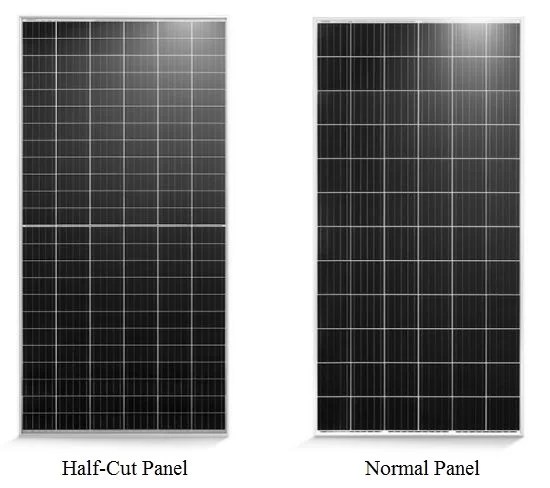
Half-split solar panels are panels that are formed by splitting the cells used in conventional panels in half and have some advantages as a result of this process. Instead of being made up of 60 or 72 cells like conventional panels, half-split solar panels are made up of 120 or 144 half-sized cells with the same structural dimensions as shown in Figure 1. Thus, a lower electrical resistance of the internal structure of the panel is achieved and the efficiency of the panel is improved. In addition, half-split panels perform much more efficiently than conventional panels in shading due to the customisation of not only the division of the cells in half, but also the shape of the connection in the panel’s internal structure. Many major panel manufacturers predict that the market share of half-cut panels will increase to 40% by 2028, given the current state of technology.
Current Value and Resistance
When a solar cell is cut in half, it has a resistance of a quarter of a normal cell and produces half the current. In this context, although the halved cells produce half the current of normal cells, since their number is twice as much as normal cells, when we connect these cells together and form a half-cut panel, the current produced by the resulting panel is equalised with the current value produced by a normal panel, while its resistance is halved. As a result of all these, the life of the panels is extended, power losses are reduced by 4 times and efficiency is increased.
Turnaround Time
In addition to having technical advantages, half-cut panels also reduce the payback period of solar energy investment. They provide much shorter payback periods than normal panels, especially in places where shadowing is predicted to occur and where there are space restrictions. In this context, with the help of the relevant panels, cost-effective investments can be made without sacrificing quality and output power.
Connection Type
A typical normal solar panel consists of 60 cells connected in series, each with a voltage of 0.5V. Since the voltages are summed in series connections, the total voltage of the panel is 30V. If the internal connections of half-cut panels are made like normal panels (Figure 2), they produce half the current and twice the voltage of normal panels. This is not a desirable situation as it will complicate the operating conditions of the inverters used in the sector. Therefore, in order for half-cut panels to operate at the voltages at which normal panels operate, their internal connections are made in a different way as shown in Figure 3. Instead of connecting all the cells in series, two groups of 60 half-cut cells are connected in series, each with an output voltage of 30V. These groups are then connected in parallel to each other and the 30V voltage is not exceeded.

2.Panel where Half-Cut cells are connected like normal cells
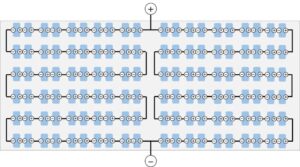
Figure 3. Correct connection form of Half-Cut cells.
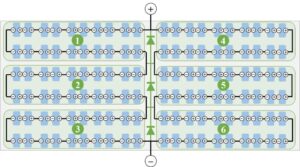
Figure 4. Cell arrays in half-cut panels.

State investment stimulation program “373”
Is a mechanism through which Moldovan producers can access long-term loans for investment.
What advantages do you have?
* You will receive compensation of interest on investment loans from the state; (The difference in interest rates will be subsidized by the Government of RM through the Entrepreneurship Development Organization (ODA))
* You pay for the loan an interest rate of only 7% in MDL or 3% in foreign currency;
* You can conclude an investment loan for a term of up to 7 years;
* The maximum amount of loans can be up to 15 million lei;
* Own contribution is only 10% of the investment project value;
* You do not pay a commission for early repayment and you have a partial exemption from bank commissions related to the loan.
* You receive a maximum guarantee of 40% of the loan amount if you do not have enough collateral;
Read More
Solar panels: service life and guarantees
The lifetime of solar panels and their output depends on many factors, including climate, type of module and installation system.
Solar panels are covered by two warranties, two types: 1) product warranty (against manufacturing defects), known in English as product warranty and 2) performance warranty.
The first type of warranty is typical for any product/good we buy. It is a warranty against failure due to manufacturing defects. For solar panels, it is higher than the standard warranty periods for many other products. The usual, most common warranty period against defect for solar modules: 10-12 years.
The most common performance warranty period for solar panels: 25 years at 80 per cent of original capacity. This does not mean that a solar panel’s life is over after 25 years. No, it can last 40 or 50 years, it is just that further degradation of the module is not described in any way by the manufacturer and is not associated with any obligations on his part.
Read More
Solar energy potential in Moldova
The development of solar energy in the Republic of Moldova remains insignificant, except for some photo-conversion plants. The theoretical solar period is 4450 h/year. The real period is assumed to be 2100-2300 h/year, about 50% less than the theoretical period.The best solar season is April-September, or 75% of the annual solar period.
Solar energy – key targets: According to the Energy Strategy, about 1 million square metres of solar installations will be installed for the purpose of (heating) hot water production and 80,000 square metres of solar installations for drying agricultural products.
I-monitoring | AI Testing and Experimentation Facility (TEF) for the energy sector – bringing technology to the market HORIZON-CL5-2024-D3-01-11
Our company Green Spark was included as a partner in the “i-Monitoring” grant application submitted to the EU HORIZON funding program under the topic HORIZON-CL5-2024-D3-01-11 AI Testing and Experimentation Facility (TEF) for the energy sector to bring technologies to market.
The thermal energy supply system for Bucharest residents is the largest in the European Union and the second after the one in Moscow. Considering its extension as well as the age of the component elements, the interventions in this system are different compared to those in other European cities. In order to respond to the modernization needs, the intervention must be done in successive steps: first, the modernization and energy efficiency of the current centralized system must be done, and in the next phase, the implementation of solutions leading to energy neutrality.
By creating the simulation system ( digital twin) of the energy system and testing it in a Bucharest district, both the management of thermal energy supply and network maintenance interventions will be improved. The platform will provide modeling, management, citizen interaction, self-optimization, decision support/scenario analysis functions for all situations encountered.
In order to create this platform, in a first phase an energy analysis will be carried out. This analysis will help design the first algorithms that will form the basis of AI learning. In the next phase, the AI of the platform will enter a learning process.
To avoid systematic errors in input data, sensors will be installed in a district in Bucharest to provide real-time data for decision-making.
By participating in this project, we will be able to identify together the best solutions to make this system more efficient and adapt it to the requirements of the citizens of Bucharest, as well as to identify transferable components and knowledge at the European level.
The aim of the project is to make the decision-making system more efficient in managing the transport and supply of thermal energy in Bucharest and Chișinău in order to modernize it, an important step in reaching the decarbonisation targets set by the European strategies.
Read More